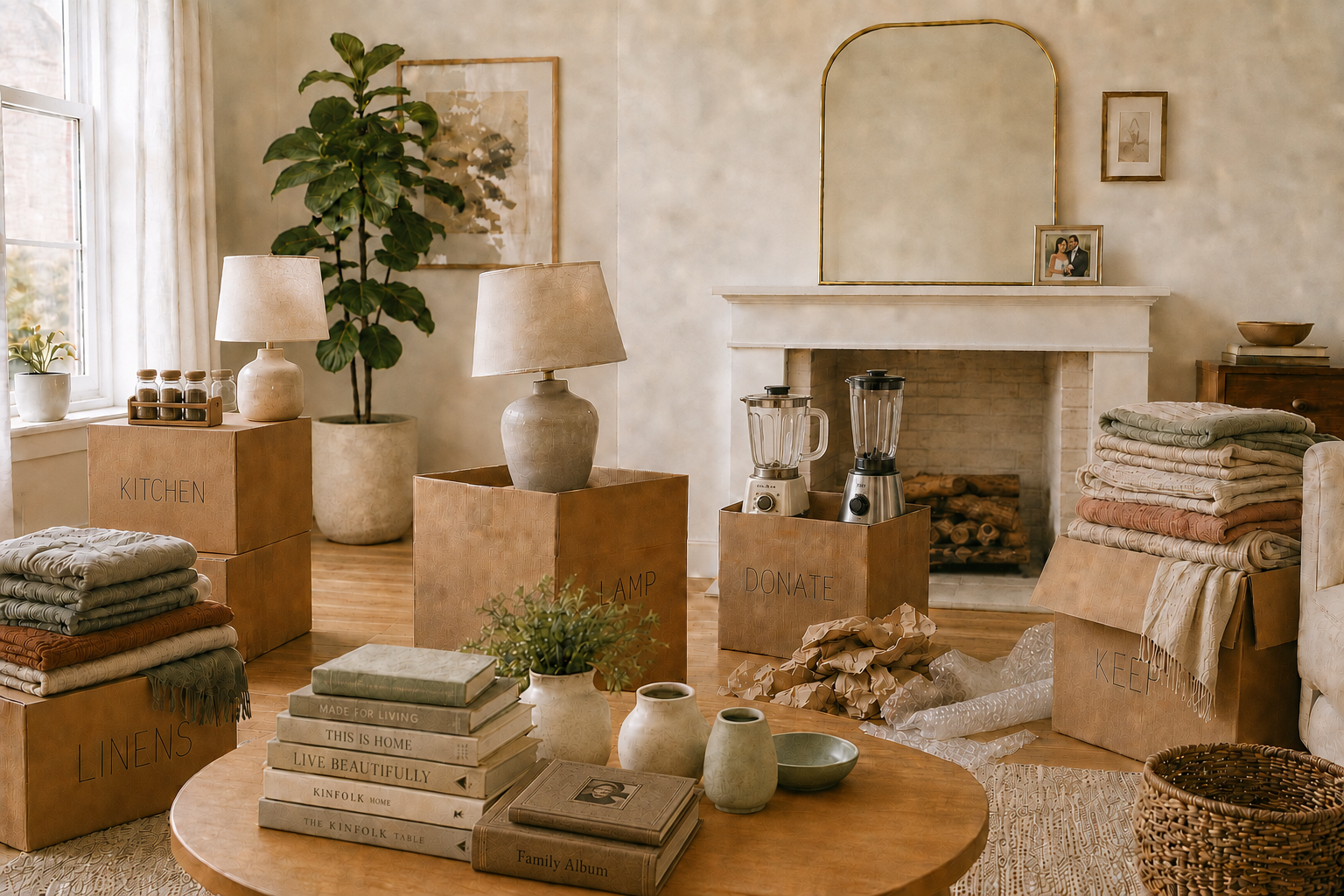
Nothing says "true love" like discovering you now own three blenders and enough throw pillows to insulate a small cabin.
For newlyweds, couples moving in together, and blended families, combining two households is an exciting transition, right up until moving day, when it quietly becomes a logistics exercise nobody signed up for.
The good news: merging households doesn't mean merging everything. With thoughtful decluttering, practical move coordination, and a sense of humour about your competing spice-rack philosophies, you can create a home that feels like both of you, not a storage unit with a mortgage.
Start with the duplicates, yes, all of them
Every couple moving in together eventually has The Toaster Conversation. You have one. They have one. Neither of you wants to part with yours, even though both make objectively mediocre toast.
When sorting duplicate belongings, the goal isn't deciding whose item "wins"; it's deciding which one earns a place in the shared home. Consider condition, quality, usefulness, sentimental value, and fit. Agreeing on criteria first keeps the conversation about the object, not a review of each other's taste.
Anything that doesn't make the cut can be sold, donated, gifted, recycled, or responsibly disposed of, exactly what a friend furnishing a first apartment may need.
Coordinate the move without losing your mind or each other
Two households can mean two timelines and two very different interpretations of "packed and ready." One person has every box labelled; the other arrives with a lamp, three grocery bags of shoes, and a houseplant with no explanation.
A shared inventory and move plan prevent both households from arriving fully stocked with nowhere to put anything, and clarifies what moves in directly, what needs temporary storage, and what gets donated or sold beforehand. Move coordination can include comparing mover quotes, scheduling packing and moving dates, arranging donations, coordinating service providers, and deciding where larger items will go.
This is also the moment to be honest about storage: "We'll figure it out later" has a way of becoming "we've been stepping around those boxes for two years."
Give sentimental belongings their own rules
Duplicate kitchenware is relatively easy math. Your grandmother's letters, your partner's childhood trophies, wedding keepsakes, or family photographs are not.
Sentimental belongings deserve a slower conversation, not the same rules as the extra colander; each person should have room to explain why something matters. The goal isn't to declutter your way through your history; it's to give meaningful belongings an intentional home, not an unlabelled box in the garage.
Create one shared home
Combining households works best when both people can see themselves in the new space. The real test isn't moving day; it's six months later, when both of you can find the scissors without forming a search party.
A shared home should be organized by function, not by "whose stuff was here first." After unpacking, take one joint pass through the home: decide where everyday items belong, create agreed spaces for paperwork and essentials, and make room for both people's routines and meaningful belongings.
Thoughtful new-home setup also includes the little comforts: making the bed, organizing the kitchen, arranging familiar photographs, and not opening twelve boxes to find a towel.
Let the transition feel like a celebration
Planning a wedding, changing cities, managing busy careers, or bringing a blended family together, organizing two homes may be the last project you want to manage alone.
Near & Dear can help with decluttering and organizing, donation coordination, move planning, service-provider coordination, packing oversight, and new-home setup across the Saanich Peninsula and Greater Victoria.
With a little support, "whose spice rack wins?" can become a five-minute laugh on moving day. Because combining two lives should feel exciting, not exhausting.
Preferably with only one blender in it.
Not sure where to start?
A short conversation is the easiest first step. We'll help you figure out what's needed.